





 Translate
 Accessibility
Riverside Park
Hippo Playground
What was here before?
This was once the land of Henry Brockholst Livingston (1757–1823), a member of New York’s influential Livingston family. He served as a Continental Army officer during the Revolution before becoming a lawyer and jurist. After a term on the New York Supreme Court, President Thomas Jefferson appointed him to the U.S. Supreme Court in 1807, where he served until his death.
Robert Livingston was the patriarch of the prominent family which includes Philip Livingston, signer of the Declaration of Independence, and Robert R. Livingston, who administered Washington’s oath and secured the Louisiana Purchase.
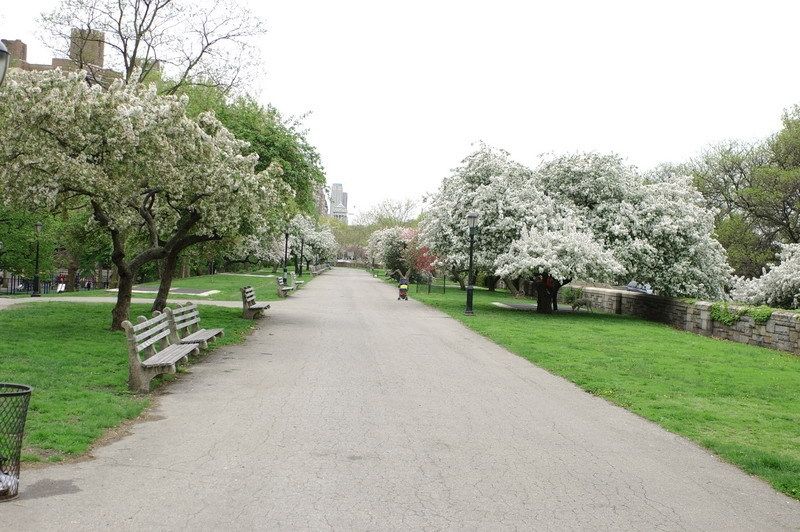
Calvert Vaux (1824-1895) and Samuel Parsons (1819-1906) laid out the southern end of Riverside Park in 1872 to enhance Frederick Law Olmsted’s (1822-1903) design for Riverside Drive. Robert Moses (1888-1981) significantly expanded the park in 1937.
How did this site become a park?
Hippo Playground, originally acquired in 1937 as part of the Riverside Park expansion and then known as the 91st Street Playground, was revitalized in 1993 through the efforts of the Playground Project and West Side Montessori School parents Julie Sakellariadis and Calleen King Letaconnoux.
Inspired by a hippo statue at the St Louis Zoo, artist Bob Cassilly designed the centerpiece hippopotamus play sculpture, leading to the park’s renaming as Hippo Playground. Renovations in 1997 and 2006 added new play equipment, safety surfaces, and upgraded amenities. The large hill on the east side of the playground is a popular sledding area for neighborhood children during the winter.
Hippo Playground is maintained by Parks in partnership with Riverside Park Conservancy. This non-profit group is dedicated to the preservation of the park= Today the park extends from 72nd Street to 158th Street. It is home to 14 playgrounds, a marina on 79th Street, as well as a series of soccer fields, baseball diamonds, basketball courts and dog runs.
What is this park named for?
The hippopotamus, which can measure up to 16 feet (5 meters) long and weigh almost 4 tons (3600 kilograms), is among the world’s largest land mammals. Although fossils indicate that hippopotami once resided in parts of India and Europe, today they are found only in the rivers of sub-Saharan Africa. Hippos are semi-aquatic, herbivorous animals, who spend most of their day underwater and usually venture onto land at night to look for food. Despite their size, they can swim swiftly underwater and run quickly on land. They live in groups of 10 to15, although herds of up to 100 have been sighted. Because many people hunt hippos for their meat and make whips from their skins, the hippopotamus population has been steadily decreasing.

Check out your park's Vital Signs
Clean & Safe
Green & Resilient
Empowered & Engaged Users
Share your feedback or learn more about how this park is part of a
Vital Park System

Know Before You Go

Related inquiries may be sent to boatbasin@parks.nyc.gov

Related inquiries may be sent to boatbasin@parks.nyc.gov
%7Cutmcsr%3D(direct)%7Cutmcmd%3D(none)%3B%2B__utmv%3D85219511.-%3B)